Math, Applied
The Star Performer Slump Is Often Math: Regression to the Mean in Real Work
The idea
Regression to the mean is a pattern, not a failure of effort. When a result is unusually high or low, the next read often moves back toward average. Part of that movement is random noise smoothing out, not proof that your intervention worked or failed.
This is different from predictive regression, which builds a formula from inputs to forecast an outcome. Same word, different tool. Here we focus on the snap-back effect after extreme scores.
Regression to the mean answers: Was last period unusually extreme, and should we expect a quieter follow-up even if nothing changed?
Example: star performers next period
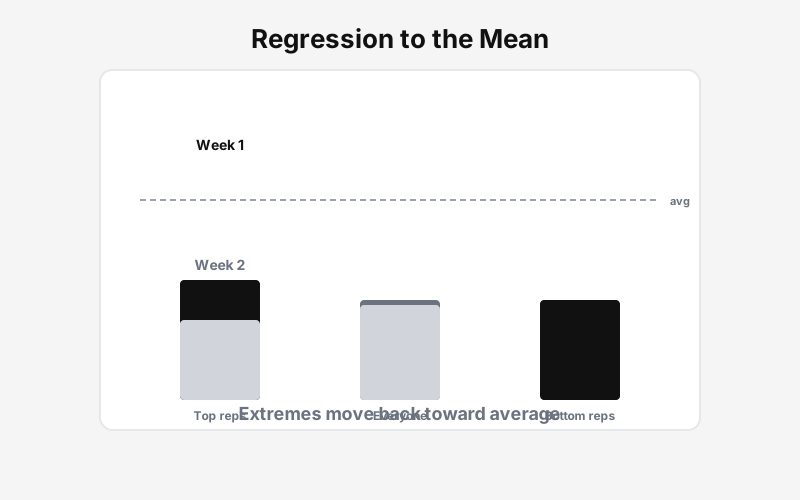
Week 1 identifies the top and bottom five. Week 2 is a fresh draw with the same underlying skill. Watch extremes move toward the team average without any coaching change.
Monthly deals closed per rep on a team of twenty
Top group drop
−2.4 deals closed
Team average (week 2)
14.7
Bottom group gain
+3.6 deals closed
Top week-1 scores often fall in week 2. Bottom scores often rise. That is regression to the mean, not proof that praise failed or punishment worked.
The math
Regression to the mean is about what happens when part of a score is luck and part is skill. Extremes in period one often look less extreme in period two even if nothing changed.
Decomposing a performance number
A rep who hits 140% of quota might have a true run rate of 105% plus a hot streak. Next quarter, the streak fades and the score drifts toward their true level. That drift is regression to the mean, not necessarily a failed incentive plan.
Expected follow-up after an extreme
Conditional on a very high result, the expected next result is usually lower because the noise component does not repeat. The same logic applies in reverse for unusually bad weeks.
Why rankings shuffle
If performance were pure skill, scores would track perfectly period to period. Real metrics correlate, but not perfectly. The gap between 1.0 and the actual correlation is room for snap-back and rank changes.
The bigger the noise relative to true skill, the larger the snap-back. Rewarding top performers or fixing bottom performers after one extreme period guarantees some regression even with zero intervention, because you selected an outlier. Longer measurement windows average out luck and stabilize rankings. Before you restructure incentives, compare against a longer baseline and ask whether the decision still makes sense if next period looks ordinary.
Where teams misread it
Sales leaders reward top reps after a blowout month, then wonder why the next month disappoints. Support managers reassign tickets away from slow agents who were unlucky for one week. Marketing kills a campaign that looked weak in a small window that was mostly noise.
Each story treats the follow-up period as evidence about people or programs. Often it is mostly the math of extremes. The top group was partly skill and partly a hot streak. The bottom group was partly a cold streak. Next period, both drift toward the team average.
What to do instead
Compare against a longer baseline, not only last period's rank. Use larger windows or control groups before you restructure incentives. When you pilot a fix on the worst performers, expect partial recovery even if the fix did nothing.
Good reviews separate signal from snap-back. Report whether the metric moved toward the long-run average, whether the sample was small, and whether the decision would still make sense if the next week looked ordinary.
Extremes get attention because they stand out. The follow-up usually looks less exciting because normal is less exciting. That is regression to the mean, and it shows up anywhere rankings meet randomness.
A simple application: after a spike week
Move last week's spike. See how much the next period is expected to cool even when nothing broke.
Spike week: expect the next period to cool
Move last week's spike. Extreme weeks often revert even when nothing changed in the product.
Spike to 145 → expect ~111 next week (-23% "drop")
Metric index
Reversion pull
Spike week
145
Expected next
111
Typical
100
Optimize (move here)
- • Compare to baseline range, not spike peak
- • Wait one cycle before rollback
Hold (do not over-react)
- • Emergency rollback on first post-spike dip
Escalate if
- • Metric stays below typical for 3+ weeks
A cooling week after a spike is often regression to the mean, not a broken launch.