Math, Applied
Percent Change Isn't Intuitive: How Growth Math Distorts Real Decisions
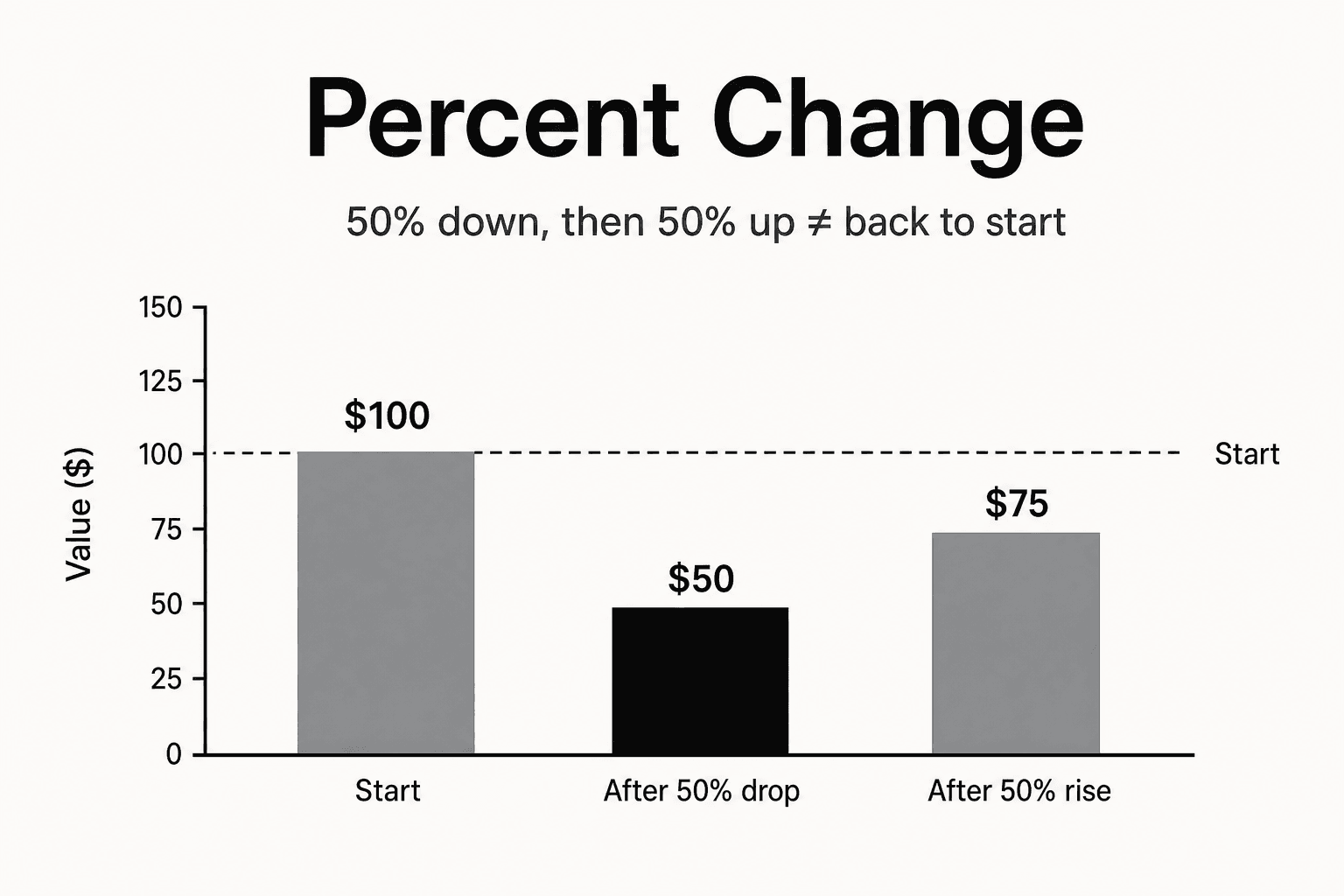
The idea
Percent change sounds straightforward. Something goes down by a percentage, then goes up by a percentage. Many people assume those moves cancel out.
For example, start with $100:
Drop 50% → $50. Then rise 50% → $75.
You are not back to $100. The second change applies to a smaller base, so it adds less than the first change removed.
Percent change is always relative to the current value. That is why the order and direction of changes matter.
Example: recovery after a drop
Start with a value, apply a drop, then apply a recovery. See why equal-looking percentages do not cancel out.
After recovery
$75
Net change
-25%
Recovery needed
+100%
A 50% drop from $100 lands at $50. A 50% increase from there only reaches $75 — not $100. To fully recover, you need a 100% increase from the bottom.
The math
Percent change is always measured from a starting value. That starting value is the denominator, and it changes after every step.
One-step percent change
Drop from $100 to $50: (($50 − $100) ÷ $100) × 100 = −50%. Rise from $50 to $75: (($75 − $50) ÷ $50) × 100 = +50%. Same percentage size, different bases, different dollar impact.
Recovery to a prior level
To return from 7,000 users to 10,000: ((10,000 − 7,000) ÷ 7,000) × 100 ≈ 43%. The drop was 30% of 10,000, but the recovery is 43% of 7,000 because the base changed.
The base in the denominator is what drives most surprises. A 10% move on $1,000 is $100; on $100 it is $10. Down then up does not undo itself because each step uses a different base. Starting near zero inflates percentages: a jump from 2 to 5 is +150%, which may be three customers. After a drop, set recovery targets from the trough, not the peak, and report absolute values alongside percentages so the audience sees whether you actually got back to the goal.
Why intuition fails
We often treat percentages like fixed units. A 10% drop and a 10% rise feel symmetric. In math, they are not, unless the rise is calculated from the original starting point, which is rarely how real metrics move.
After a decline, the base is lower. A recovery percentage only restores part of what was lost. The bigger the initial drop, the larger the recovery percentage you need to return to the start.
This shows up in revenue reports, product metrics, and personal finance. The headline can say "we bounced back 50%" while the business is still below where it began.
A simple application: metric recovery
Imagine monthly active users fall from 10,000 to 7,000. That is a 30% drop. Leadership wants growth back and celebrates a 30% increase the next month.
Metric recovery: percent back vs back to baseline
Set the drop and the recovery percent. See why matching the drop percent does not restore the baseline.
+30% recovery leaves you 900 users short of baseline
User path
Recovery needed vs chosen
You chose: +30% · To baseline: +43%
Baseline
10,000
After recovery
9,100
Gap to baseline
900
Optimize (move here)
- • State targets in absolute users when recovering
- • Calculate recovery from new base
Hold (do not over-react)
- • Celebrating symmetric % when bases differ
Escalate if
- • Board target is baseline but plan uses drop % only
You need about +43% from the trough to fully recover, not +30%.
A 30% increase from 7,000 is 2,100 users, which brings you to 9,100 — still below 10,000.
To return to 10,000 from 7,000, you need about a 43% increase, not 30%.
The gap between "recovery percentage" and "back to baseline" is where many dashboards and narratives go wrong. Teams set targets using the original drop number, then wonder why they miss the goal.
The fix is not more optimism. It is calculating recovery from the new base, or stating targets in absolute terms when clarity matters.
Percent change is a lens, not a complete story. It tells you how much something moved relative to where it was, not where you started across multiple steps.
When reporting a drop followed by a rebound, show three numbers: the starting value, the low point, and the current value. Then the audience can see the real gap without doing mental math.
When setting goals after a decline, calculate the required recovery from the trough, not from the original peak. That single habit prevents a large class of planning mistakes in growth, operations, and forecasting.
Most percent-change mistakes are not calculation errors. They come from assuming symmetry where none exists.
Once you treat each percentage as relative to its own base, the numbers become easier to interpret and easier to communicate. You stop asking why a 50% recovery did not undo a 50% drop — and start designing targets that match reality.