Math, Applied
Up 10% Compared to What? Benchmarks and Baselines
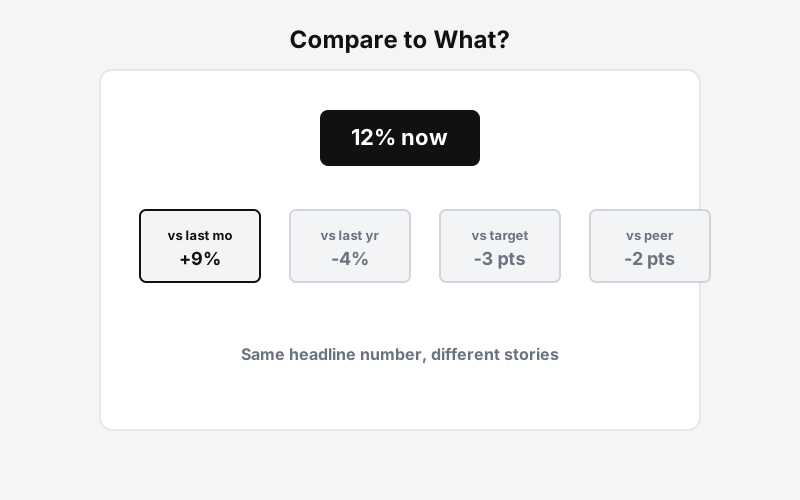
The idea
A metric without a baseline is half a sentence. Conversion is 11%. Revenue is $820k. CSAT is 78. Each number needs a comparison before it means anything for a decision.
Remember it in one line: say the number, then say compared to what.
Last month, same month last year, plan target, and peer median can tell four different stories about the same current value. Pick the baseline that matches the question you are actually trying to answer.
Benchmarks answer: Is this good or bad, relative to the right reference point?
Example: one number, four baselines
The current metric stays fixed. Change the baseline and the story changes. Up vs last month can still be down vs last year or below plan.
Q3 signup conversion readout for leadership
Current conversion rate
11.0%
| Baseline | Baseline value | Change | Read |
|---|---|---|---|
| Last month | 10.1% | +0.9 pts | Ahead of last month (+0.9 pts). |
| Same month last year | 11.5% | -0.5 pts | Behind same month last year (-0.5 pts). |
| Company target | 12.0% | -1.0 pts | Behind company target (-1.0 pts). |
| Industry peer median | 13.0% | -2.0 pts | Behind industry peer median (-2.0 pts). |
Short-term win, long-term miss: month-over-month looks good but the longer baseline tells a different story.
Seasonality and a product launch make year-over-year the fairer read than month-over-month.
Rule of thumb: say the number, then say compared to what.
The math
Relative change (rates and dollars)
$820k vs $780k last month is +5.1%. Same $820k vs $850k target is −3.5% vs plan. Same current value, opposite headline depending on baseline.
Absolute gap (scores and rates)
11.0% conversion vs 12.0% target is −1.0 point, not −8.3%. Points and dollars are often clearer than percents when the baseline is a goal or peer level.
Which baseline when
Month-over-month for weekly standups. Year-over-year for seasonal businesses. Target for board and budget reviews. Peer for competitive context. Mixing them without labels causes arguments.
A simple application: the leadership slide
A PM puts conversion at 11% on a slide with a green arrow because it beat last month. Finance notes the same 11% misses the 12% target. Strategy adds that peers sit near 13%. Everyone looked at one number. They answered different questions.
Leadership slide: one number, four baselines
Move conversion and see how the same 11% answers different questions vs last month, plan, and peer.
11% conversion — green vs last month, red vs plan and peer
Vs baselines (pp diff)
Last mo: +1.0 pp · Last yr: +1.5 pp · Plan: -1.0 pp · Peer: -2.0 pp
Absolute levels
You: 11% · Plan: 12% · Peer: 13%
Conversion
11%
Vs plan
-1.0 pp
Vs peer
-2.0 pp
Optimize (move here)
- • One headline metric + small baseline table on every leadership slide
Hold (do not over-react)
- • Debating MoM alone for seasonal businesses
Escalate if
- • Plan and peer baselines disagree on direction
Pick the baseline that matches the decision before the room debates the arrow color.
Fix: one headline metric, then a small baseline table: vs last month, vs last year, vs plan, vs peer. State which baseline drives the decision. Percent change posts cover the arithmetic. This post covers the choice before you calculate.