Math, Applied
Your Best Customers Answered: Selection Bias in Real Decisions
The idea
Selection bias happens when the sample you measure is not the population you care about. Surveys reach responders. Betas reach volunteers. Churn interviews reach people willing to talk. The rate in that slice can look nothing like the rate for everyone.
Selection bias answers: Who never made it into this dataset, and would the headline change if they had?
Example: who is in the sample?
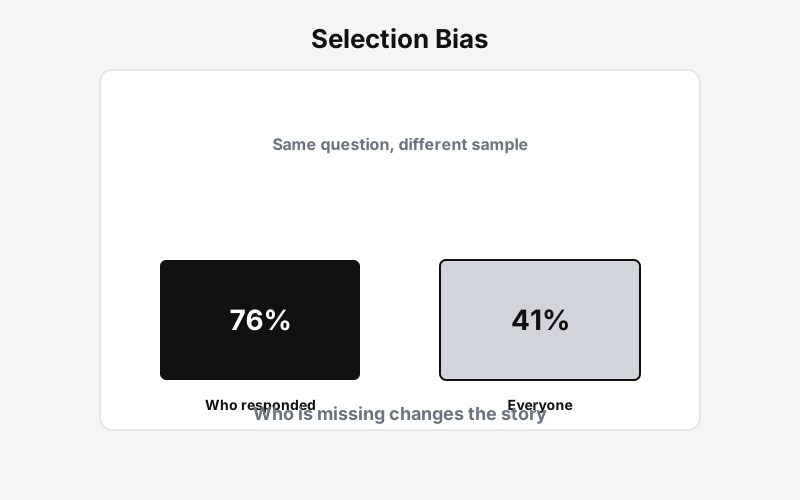
Compare the group you measured with the full population. When the sample is self-selected, the headline rate can look much better than reality.
Do customers love the new dashboard?
Selected sample
76%
n = 420
Full population
41%
n = 12,000
Gap
+35 pts
sample vs everyone
319 positive in sample vs 4,920 if the rate applied to all
Who is missing: Customers who ignore surveys (often less engaged or less satisfied). Survey respondents are not a random slice. They skew toward power users.
The math
Selection bias is a gap between the rate in your sample and the rate in the population you actually need to decide for.
What you measured
If 72% of survey responders are satisfied but only 45% of all customers are, the observed 72% describes responders, not everyone. The explorer shows both bars side by side.
What you need for decisions
This includes silent non-responders, users who churned before the survey, and customers who never opened the beta invite. Table 1 compares selected vs full populations across scenarios.
Size of the distortion
A +27 point gap means your sample overstates satisfaction (or conversion, or feature love) by that much. Acting on the selected rate alone scales the wrong story.
Engaged users and happy customers over-represent in voluntary samples, so the gap widens as response rate falls. Weighting by segment can close part of the difference when you have behavioral data on non-responders. A larger sample does not fix the problem if the missing customers never entered the dataset. The survey still tells you about responders; the mistake is treating that rate as the population rate without checking who is absent.
Business examples
Product teams launch features because beta users loved them. Marketing scales messages that tested well with engaged email openers. Policy teams act on complaints from the customers who fill out forms. In each case, the measured group is easier to reach, more motivated, or more patient than the full base.
| Scenario | Selected sample | Full population | Gap | Ops read |
|---|---|---|---|---|
| Feature survey | 76% (n=420) | 41% (n=12,000) | +35 pts | Survey respondents are not a random slice |
| Beta program | 82% (n=180) | 38% (n=8,500) | +44 pts | Beta lovers are a self-selected group |
| Churn interviews | 58% (n=65) | 22% (n=2,400) | +36 pts | Interview samples miss the silent majority |
What to do instead
Report who is in the sample and who is missing. Weight or stratify when you can. Compare survey results to behavioral data on non-responders. For betas, read holdout groups that did not opt in. For churn, pair interviews with exit data on silent leavers.
A high score from a biased sample is still data. It is just data about the selected group. Treat it that way before you set roadmaps or revenue targets.
A simple application: survey bias
Lower response rate and happy-user bias. See when reported satisfaction overshoots the true population.
Survey bias: who answered vs who matters
Lower response rate from unhappy users. Reported satisfaction can look fine while the silent majority differs.
Reported 79% satisfied — true population ~62%
Satisfaction (%)
True pop.: 62% · Reported: 79%
Sample quality
Reported CSAT
79%
True CSAT (est.)
62%
Gap
17 pp
Optimize (move here)
- • Weight responses by segment size
- • Track non-respondent cohort behavior
Hold (do not over-react)
- • Roadmap from survey alone after beta invite
Escalate if
- • Usage metrics disagree with survey for two cycles
Best customers answered. Weight by segment or follow up with silent users before product calls.