Math, Applied
You Hit the Target and Missed the Point: Goodhart's Law
The idea
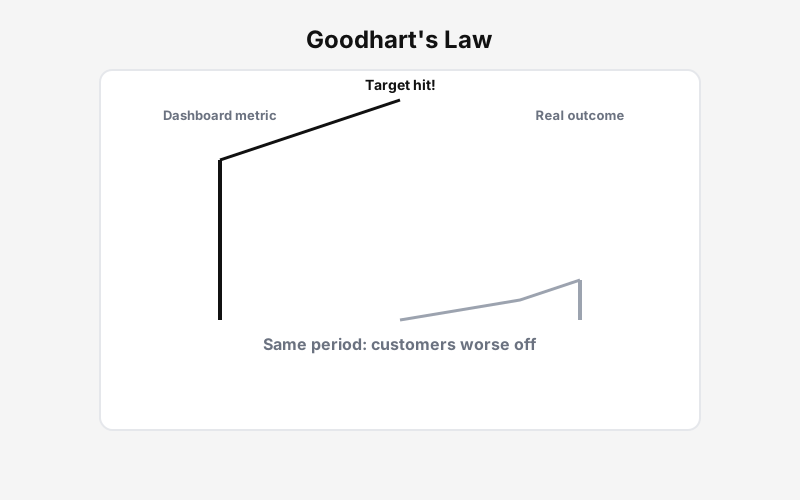
Goodhart's law is the trap where a stand-in number stops standing in for what you care about. Teams optimize the chart because the chart is what gets rewarded. Tickets close faster. Calls pile up. Click rates spike. Meanwhile satisfaction, revenue, and trust quietly slide.
Remember it in one line: when the measure becomes the target, it stops measuring what matters.
That is different from a bad metric chosen once. Goodhart is what happens after bonuses, rankings, and OKRs lock onto that metric. People are rational. They hit the number you pay them to hit.
Goodhart's law answers: Is the dashboard green because we are winning, or because we learned to game the proxy?
Example: watch the dashboard and the real outcome diverge
Drag target pressure: bonuses, reviews, and quotas tied to the metric. The reported number rises. The outcome you actually care about often falls.
Team is rated on tickets closed per hour
Dashboard: Tickets closed / hour
10
Looks better as pressure rises
Reality: Customer satisfaction
63%
Often slides down as pressure rises
Dashed line: the wider the gap, the less the metric tells you
The gap is opening
Tickets closed / hour rose to 10 as pressure increased.
Customer satisfaction fell to 63% (still aligned).
You hit the target and missed the point: the measure improved while the thing you actually care about slid.
The math
Two different numbers
Tickets closed per hour is a proxy. Customer satisfaction is the outcome. They often move together at first. Under heavy target pressure, the proxy keeps rising while the outcome falls.
The usual pattern
Not every team games metrics on purpose. Pressure makes the easiest path to the target the path of least resistance: rush, reclassify, cherry-pick, or shallow wins.
Early warning
When the dashboard and customer reality diverge, the metric is still a number. It just is not your number anymore. Track the outcome beside the proxy, not instead of thinking about proxies.
A simple application: support team targets
A support org bonuses on tickets closed per hour. The line goes up in weekly reviews. CSAT and reopen rates worsen at the same time. Leadership celebrates throughput until churn spikes in the next quarter.
Support targets: proxy vs outcome
Raise pressure on tickets closed per hour. The proxy rises; CSAT and reopen rates fall.
Closes/hr 85 ↑ but outcome score 47 ↓
Scores
Target pressure
Proxy metric
85
Outcome
47
Pressure
7/10
Optimize (move here)
- • Pair proxy + outcome in every review
- • Cap how much one metric drives pay
Hold (do not over-react)
- • Bonuses on closes/hr alone
Escalate if
- • Reopen rate worsens while proxy improves
Pair proxy with outcome every review. If hitting the metric tomorrow would embarrass you, it is Goodhart.
Fix: pair the proxy with the outcome in every review (closes and satisfaction), rotate spot checks, and cap how much one metric alone can drive pay. If you must pick one number for a bonus, pick the outcome and use proxies as diagnostics only.
The memorable test: if your team hit the metric tomorrow with a shortcut everyone would regret, would you still call it success? If not, you are looking at Goodhart, not a bad week.