Math foundations
Expected Value: The Pure Definition
The idea
Expected value is not optimism. It is a weighted average of outcomes, where each outcome is multiplied by its probability. One big win and many small losses can still average to a negative number. The lottery is the classic example: a huge jackpot with tiny probability often loses money on average once ticket cost is included.
EV answers a long-run question: if you repeated the same bet many times, what would you earn or lose per trial on average? It does not promise any single trial will land near that number. It compares options on one scale before you commit.
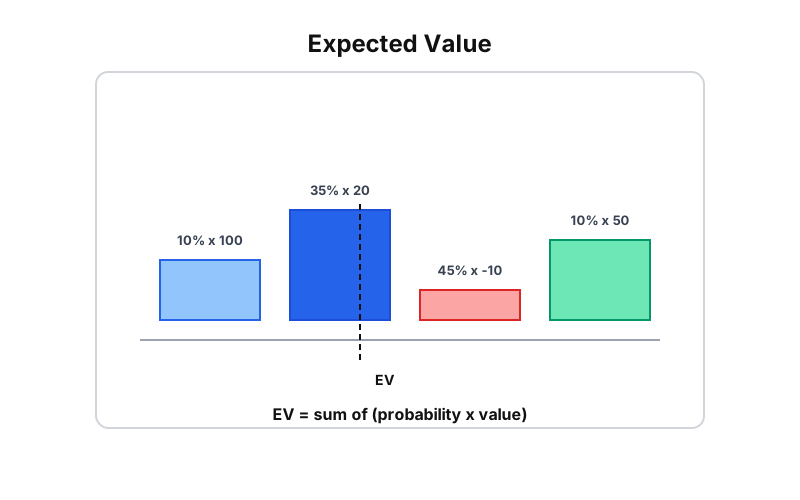
EV = sum of (probability x value). Probabilities across all outcomes must sum to 1.
Example: build expected value from outcomes
List every outcome, assign a probability to each, assign a numeric value. Expected value is the probability-weighted average: EV = sum of (p x value). One flashy upside does not help if its probability is tiny.
Rare big win, common small wins, and frequent losses.
Big win
Contribution: 10.0% x 100 = 10.00
Small win
Contribution: 35.0% x 20 = 7.00
Loss
Contribution: 55.0% x -10 = -5.50
Contribution bars: each outcome's p x value
Outcome values on a number line (bar height = probability)
Expected value
11.50
Probability sum
100%
Probabilities sum to 100%. Outcome weights are valid.
| Outcome | p | Value | p x value |
|---|---|---|---|
| Big win | 10.0% | 100 | 10.00 |
| Small win | 35.0% | 20 | 7.00 |
| Loss | 55.0% | -10 | -5.50 |
| Expected value (sum) | 11.50 | ||
Expected value is +11.50. If you repeated this bet many times, you would come out ahead on average by about 11.50 per trial.
Step by step
1. List outcomes. Every mutually exclusive case that can happen: win big, win small, lose, break even. Do not leave gaps.
2. Assign probabilities. Each outcome gets a weight between 0 and 1. All weights together must sum to 100%.
3. Assign values. Use the same unit for every outcome: dollars, points, hours saved. Losses are negative.
4. Multiply and add. Each row contributes p x value. Expected value is the sum of those contributions.
The math
Definition
Probabilities should sum to 1 across the full outcome set.
Per-outcome weight
Each outcome pulls EV toward its value in proportion to how likely it is. Rare huge wins contribute little unless probability is high enough.
Fair bet
A fair coin win/lose game with equal payoffs has EV = 0. Individual trials still swing; the long-run average sits at zero.
Common mistakes
Using the best-case outcome instead of the full list. Forgetting to include losses or costs. Probabilities that do not sum to 100%. Treating a positive EV as a guarantee for one try. EV ranks bets; it does not remove variance or downside risk.
A simple application
Once EV is clear, campaign bets, inventory policies, and pipeline choices become comparable on one scale instead of best-case storytelling. The applied posts on expected value, probability, and stockout risk layer business costs and constraints on top of this definition.