Math, Applied
Expected Value: Compare Bets Without Guessing
The idea
Expected value is a weighted average of outcomes. You combine upside, chance, and cost into one number: what you would earn on average if you ran the same bet many times. It does not promise any single launch will win. It helps you compare options before you commit budget.
Expected value answers: Which choice is better on average, not which one has the best story?
Example: compare two bets
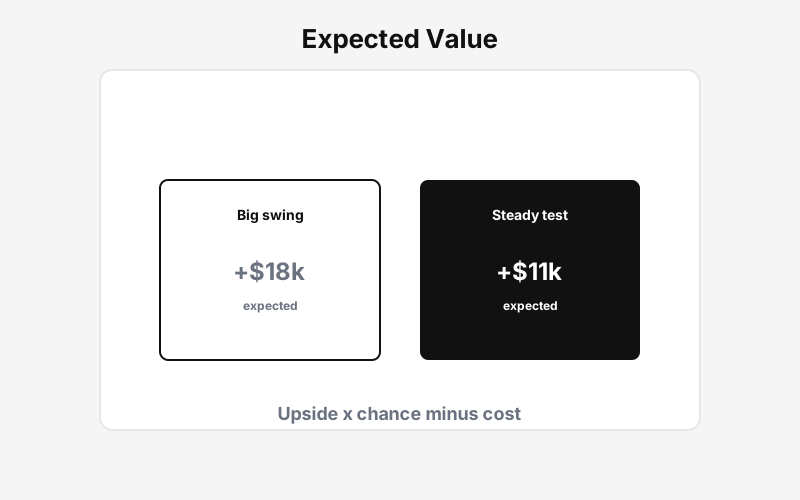
Expected value blends upside, chance, and cost. A big swing can lose on average even when the jackpot sounds exciting. Drag the sliders on each option.
Big swing campaign
+$17.6k
expected profit
EV = (18% × $320k) − $40k
Steady email test
+$11.1k
expected profit
EV = (42% × $55k) − $12k
Option A leads by about +$6.5k in expected profit.
Probability first
Expected value sits on top of probability. Before you multiply by payout, you need a read on how likely each outcome is. The dedicated posts on probability, base rates, and confidence intervals cover how to estimate that chance and when to trust it.
Mutually exclusive outcomes
A campaign either clears its ROI bar or it does not. That is why the explorer uses win chance and treats the rest as the miss case.
Probabilities must reflect the population you care about, not only survey responders or beta opt-ins. Bad inputs make expected value fiction. Start with successes and trials, then check sample size and interval width before you plug a rate into EV.
The math
Once you have probabilities, expected value weights each outcome and nets out cost.
Expected value of a single bet
p is win probability. If you win $50k with 20% chance, lose $5k otherwise, and spend $8k to run the campaign: EV = (0.20 × $50k) + (0.80 × −$5k) − $8k = $10k − $4k − $8k = −$2k. Negative EV means you lose on average even though the upside story sounds big.
Many outcomes
Launch might flop, break even, or hit big. Assign a probability to each outcome, multiply, and add. The explorer compares two options with different cost, win rate, and payout structures.
A small shift in p can flip which option wins on average. Big upside only helps if p is high enough to matter. Two options with the same payout and odds rank differently when cost differs, so always net out cost.
A simple application: comparing bets
Marketing and growth. Compare a high-cost brand campaign with low hit rate against a cheaper always-on test with modest upside. Finance asks which spends more per expected dollar returned.
Comparing bets: rank on expected value
Move probability and payoff on two bets. EV ranks pipeline on average return, not best-case deck slides.
Bet A wins on EV — A: $1.50M vs B: $1.38M
Expected value ($M)
Bet A: $1.50M · Bet B: $1.38M
Win chance (%)
Bet A: 15% · Bet B: 55%
EV Bet A
$1.50M
EV Bet B
$1.38M
Pick
Bet A
Optimize (move here)
- • Write probability and payoff before comparing bets
- • Rank pipeline on EV not logo size
Hold (do not over-react)
- • Funding highest upside deck without odds
Escalate if
- • EV winner differs from strategic must-win account
Big logo, low odds can beat three modest deals on average return.
Product bets. Build a major feature with uncertain adoption vs ship a smaller improvement with clearer payoff. EV forces you to write down adoption chance, not only the best-case deck slide.
Sales and partnerships. A big deal with a 15% close rate vs three smaller deals at 55%. Expected value ranks the pipeline on average return, not on the single largest logo.
Ops and tooling. Automate a workflow now with known savings vs wait for a platform rewrite with higher upside but long delay and execution risk. Cost, timing, and probability all belong in the same frame.
| Option | Cost | Win chance | Payout if win | Expected profit |
|---|---|---|---|---|
| Big swing campaign | $40k | 18% | $320k if win | +$17.6k |
| Steady email test | $12k | 42% | $55k if win | +$11.1k |
Limits and habits
You still need good inputs. If win rates are made up, expected value is fiction. Pair EV with sample size, intervals, and downside caps. Use it to rank options, not to ignore risk entirely.
When two options are close in expected value, execution cost, speed, and reversibility break the tie. When one option leads by a wide margin, you have a clear math case to discuss with stakeholders.