Math foundations
Eigenvalues: Stretch Factors Along Special Directions
The idea
Most linear transforms rotate and stretch at once. Eigenvalues are the stretch amounts along directions that do not rotate. For a covariance or correlation matrix, the largest eigenvalue tells you how much variance lives on the dominant axis. That is the same intuition behind PC1 variance explained.
Eigenvalues answer: How strongly does this transform amplify motion along each special direction?
Example: stretch factors along eigen-directions
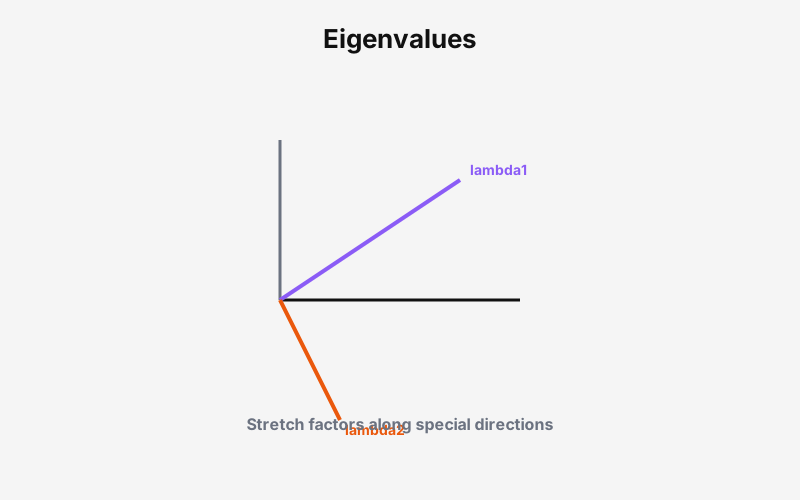
Eigenvalues tell you how much a symmetric transform stretches along each special direction. Arrow length tracks |λ|.
Revenue and orders co-move. Eigenvalues rank how much each axis stretches variance.
| Matrix A | col 1 | col 2 |
|---|---|---|
| row 1 | 2.40 | 1.10 |
| row 2 | 1.10 | 0.90 |
λ₁ (largest |λ|)
2.86
λ₂
0.64
PC1-style share
82%
PC2-style share
18%
Eigenvalue magnitudes |λ|
Revenue and orders co-move. Eigenvalues rank how much each axis stretches variance. λ₁ = 2.86 carries 82% of stretch. One composite axis (like PC1) explains most variance.
The math
Eigenpair
Vector v is an eigenvector. Scalar λ is its eigenvalue. Applying A to v only scales v; it does not turn v onto a new direction.
Characteristic equation
For a 2×2 matrix, this quadratic gives two eigenvalues (possibly equal). Solve for λ, then find v from (A − λI)v = 0.
Stretch and PCA
On symmetric covariance matrices, eigenvalues equal variance along each principal component. The ratio λ₁ / (λ₁ + λ₂) matches variance explained by the first axis.
A simple application
In PCA readouts, rank eigenvalues before you trust a one-chart summary. If λ₁ explains most variance, a composite KPI score is reasonable. In dynamical systems, eigenvalues near 1 mean slow decay; values above 1 mean instability. Check both the stretch and the direction (eigenvectors post).