Math foundations
Eigenvectors: Directions That Only Stretch, Not Rotate
The idea
Pick a random direction and apply a matrix: the vector usually rotates and changes length. Eigenvectors are the exceptions. They stay on their line; the matrix only scales them by the matching eigenvalue. For symmetric data matrices, those directions are orthogonal and become the principal axes in PCA.
Eigenvectors answer: Which directions carry independent variance without mixing into each other?
Example: directions that only stretch
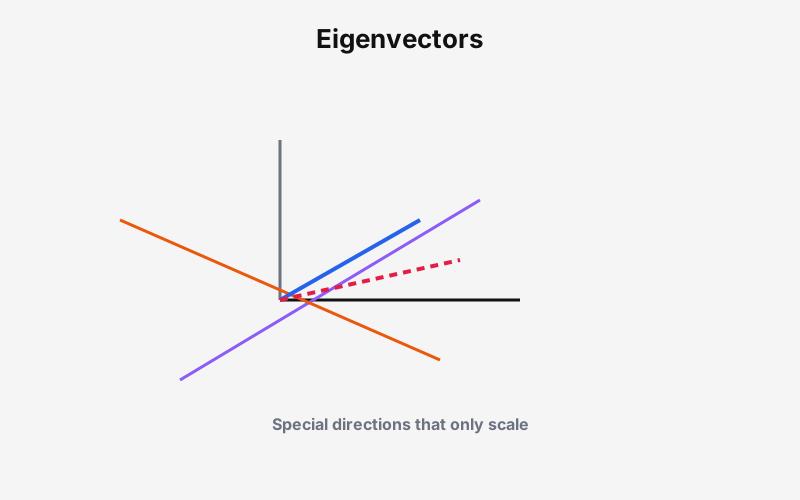
Eigenvectors stay on their line under A. Every other direction rotates and stretches together.
Revenue and orders share variance, but each principal axis is an eigenvector direction.
λ₁ on v1
2.62
λ₂ on v2
0.48
On eigen axis?
No
Revenue and orders share variance, but each principal axis is an eigenvector direction. At 35°, a general vector rotates and stretches. Eigenvectors at λ₁ = 2.62 and λ₂ = 0.48 are the only directions that scale cleanly.
The math
Fixed direction
v is an eigenvector if A sends it to a scalar multiple of itself. λ is how much length changes along that line.
Symmetric matrices
Real symmetric A has real eigenvalues and perpendicular eigenvector pairs. That is why PCA axes are at right angles after centering and scaling.
PCA link
Principal components are eigenvectors of the covariance matrix ordered by eigenvalue size. PC1 is the direction of maximum variance.
A simple application
When three KPIs move together, they are not three independent levers. Eigenvectors name the axes that actually carry separate signal. Use PC1 for the combined health score, PC2 for the secondary story, and ignore tiny components that are mostly noise. Pair this with the eigenvalues post to see how much each axis matters.