Math foundations
Determinants: Area Scale Factor of a Linear Map
The idea
The determinant of a square matrix is a single number that summarizes how a linear transformation stretches, flips, or collapses space. In two dimensions, it is the signed area of the parallelogram spanned by the column vectors. In three dimensions, it becomes a signed volume.
det = 0 means the map squashes dimension: two different inputs can land on the same output. That is singularity. Non-zero determinant means the system has a unique inverse, which is what you need before trusting a unique solution to Ax = b.
|det| tells you how much area (or volume) scales. Sign tells you if orientation flips.
Example: 2×2 determinant as signed area
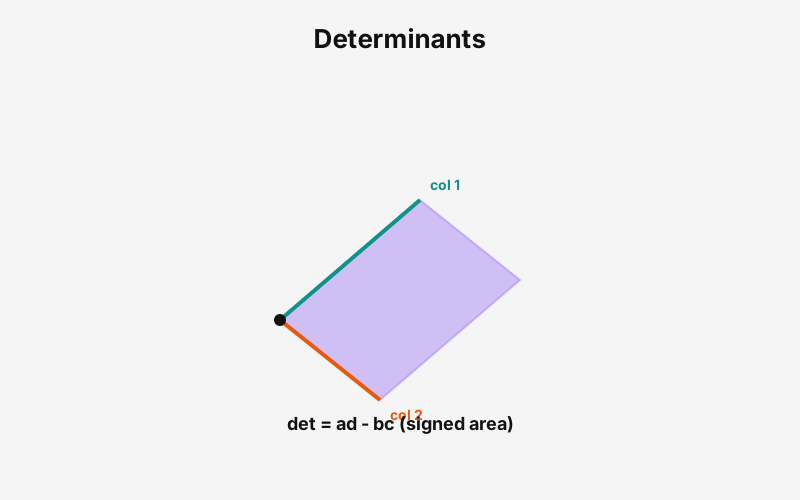
Columns of the matrix are two vectors in the plane. Their determinant is the signed area of the parallelogram they span. Drag the entries and watch area grow, shrink, or collapse.
Matrix
[2.00, 1.00]
[0.50, 1.50]
Formula
det = ad − bc
= (2.00)(1.50) − (1.00)(0.50)
det
2.50
|det| area
2.50
Status
Invertible
Parallelogram spanned by column vectors
Teal and orange columns sweep out a violet region. Its signed area equals det.
Area scale from |det|
det = ad − bc = 2.50. Signed area is positive; absolute area is 2.50. The linear map scales 2D area by a factor of 2.50. Non-singular: the map preserves dimension. You can recover inputs from outputs, which is what solving Ax = b requires.
Building blocks
Column vectors. Each column of a 2x2 matrix is a direction in the plane. Together they sweep out a parallelogram anchored at the origin.
Signed area. Positive determinant keeps orientation. Negative determinant reflects the shape. Zero determinant collapses area to a line or point.
Invertibility. Non-singular matrices can be undone. Singular matrices lose information, like parallel constraints that do not pin down a unique answer.
The math
2×2 determinant
Multiply down the main diagonal, subtract the cross diagonal. This is the signed area of the parallelogram built from columns (a,c) and (b,d).
Geometric meaning
A unit square maps to a region whose area equals |det|. det = 2 doubles area. det = 0.5 shrinks area by half.
Collapse
Parallel column vectors give zero area. The linear system has either no solution or infinitely many, not a unique one.
Product rule intuition
Apply transformation A, then B. Area scales by det(A), then again by det(B). The combined scale is the product. Helpful when reasoning about chained feature transforms.
Where teams get stuck
Treating determinant as a mysterious symbol instead of a scale factor. Checking only whether det is positive without looking at magnitude. Ignoring near-zero determinants in numeric systems where columns are almost parallel. Confusing determinant with matrix size or row count.
In practice, a tiny |det| signals ill-conditioning: small input changes can swing outputs wildly, even before you hit exact zero.
A simple application
When feature transforms chain together, the volume of reachable outcomes scales with products of determinants. Invertibility checks mirror whether a model system has a unique calibration. The matrices and linear systems post names Ax = b; this post explains when that system has a stable, reversible geometry behind it.