Math foundations
Probability Basics: Events, Joint Probability, and Independence
The idea
Probability starts with events: single outcomes or groups of outcomes you care about. Before win rates, base rates, or screening tests, you need a clean vocabulary for how events combine and when one event changes the odds of another.
Joint probability answers how often two events both happen. Independence means learning that one event happened does not change the probability of the other. That distinction is easy to skip, and it is one of the most common sources of overconfident forecasts.
Independence check: P(A and B) = P(A) x P(B). If that fails, do not multiply.
Example: events, joint probability, and independence
An event is one outcome you care about. Joint probability is how often two events both happen. Independence means learning one event happened does not change the odds of the other.
Flip two fair coins. What is the chance both land heads?
P(A)
50.0%
Heads on coin 1
P(B)
50.0%
Heads on coin 2
P(A and B)
25.0%
Both heads
P(not A)
50.0%
Complement of A
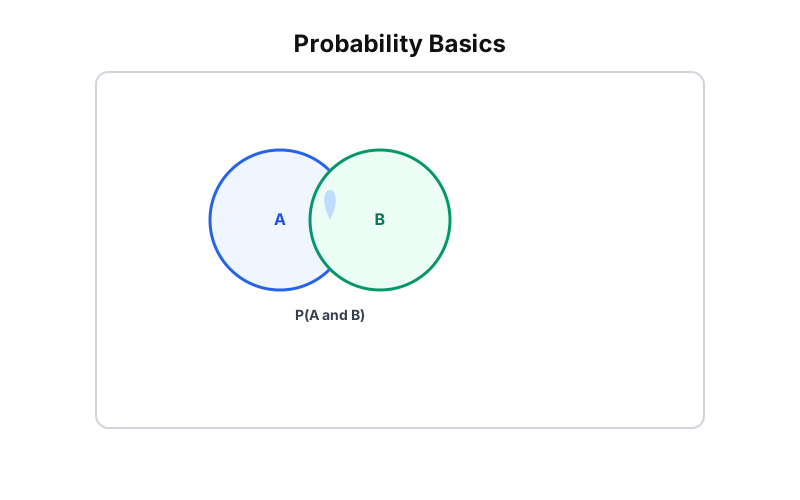
Venn view: overlap is P(A and B)
Compare: actual joint vs P(A) x P(B)
Sample space for two coin flips (four equally likely outcomes)
HH
25.0%
HT
25.0%
TH
25.0%
TT
25.0%
If independent: P(A) x P(B)
25.0%
Match?
Yes
Events are independent.
Independent events: P(A and B) = P(A) x P(B) = 50.0% x 50.0% = 25.0%. That matches the joint probability 25.0%. Classic independent case: each flip does not affect the other.
Building blocks
Sample space. The full list of possible outcomes. Two coin flips give four outcomes: HH, HT, TH, TT. Each single outcome in a fair setup has probability 1/4.
Event A. A subset you label, such as heads on coin 1. You add probabilities of outcomes that belong to A.
Complement. Not A covers every outcome where A did not happen. If P(A) = 0.3, then P(not A) = 0.7. The two must sum to 1 when A is either true or false.
Joint event. A and B means both happen. On the Venn diagram, that is the overlap. On the coin grid, it is the cells where both conditions are true.
The math
Event probability
Probabilities are never negative and never above 100%.
Complement
If 30% of days are rainy, 70% are not. Complements are useful when you know one side of a yes/no split more reliably.
Independence
Multiply only when events do not affect each other. Two fair coin flips qualify. Drawing cards without replacement does not.
Union (either event)
When events can overlap, subtract the joint region once so you do not double count.
When independence breaks
Without replacement, the deck changes after the first draw. Rain and traffic move together on many commutes. A user who already converted is no longer in the not-yet-converted pool. In each case, P(B) after seeing A is not the same as P(B) before.
Treating dependent events as independent makes joint probability look too small or too large. That error shows up in security screening, funnel math, and any model that multiplies step-by-step conversion rates without checking overlap.
A simple application
This is the language behind base rates, false alarms, and many A/B test assumptions. When events are dependent, multiplying probabilities overstates or understates confidence. The applied posts on probability, base rates, and false alarms build directly on these rules with business numbers.