Math foundations
Dependent Chains: Funnel Math Without Bogus Independence
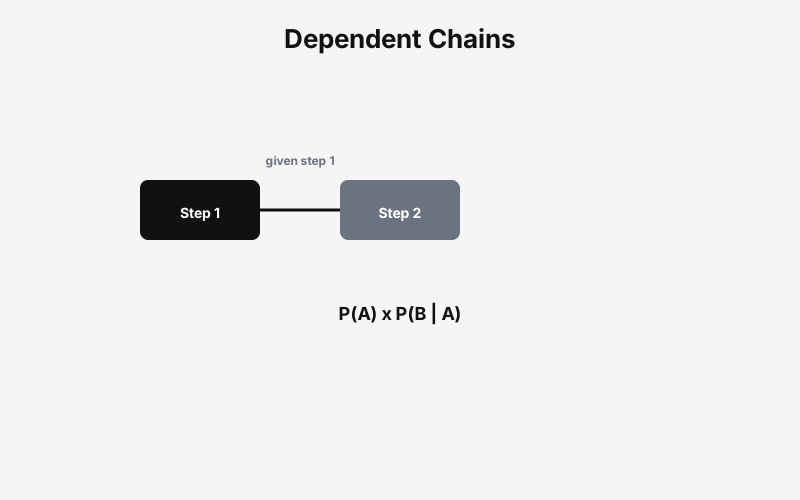
The idea
Product funnels, sales pipelines, and onboarding flows are chains of steps. Step two often depends on step one. Users who never signed up cannot activate. Prospects who never booked a demo cannot close.
Multiplying two headline rates as if they were independent inflates or deflates the joint outcome. The correct path probability uses the conditional rate on the people who actually reached step two.
Dependent chains answer: What fraction complete the full path when step two only applies after step one?
Example: chain steps with P(step2 | step1)
Drag step rates. The joint path probability is P(step1) times P(step2 | step1), not two unrelated marginals multiplied.
40% sign up, 55% of signups activate. The funnel is not 22%.
Correct joint
22.0%
P(step1) x P(step2 | step1)
Wrong shortcut
14.0%
Treats step2 as independent
Correct: P(step1) × P(step2 | step1) = 22.0%. Multiplying by an unrelated 35.0% rate gives 14.0% and overstates the funnel by 8.0%.
The math
General product rule
When B depends on A, use P(B | A), not P(B) from the whole population. Independence is the special case where P(B | A) = P(B).
Two-step funnel
Signup then activate: 40% sign up and 55% of signups activate gives 22% end-to-end, not 40% times a unrelated activation rate across all visitors.
Longer chains
For three steps, multiply along each branch: P(s1) × P(s2|s1) × P(s3|s1,s2). Report conditional conversion per step in dashboards so teams see where drop-off happens.
A simple application
Growth reviews often cite step-two conversion without reminding the room that it conditions on step one. Ops planning from a bogus joint rate misallocates effort. Fix the denominator before you fix the copy on step two.
The habit: every funnel slide shows conditional step rates and the joint path rate computed correctly. Pair with the independence post when someone multiplies unrelated probabilities across a journey.