Math, Applied
Prime Factorization Isn't Just Math: It's How You Break Down Real Problems
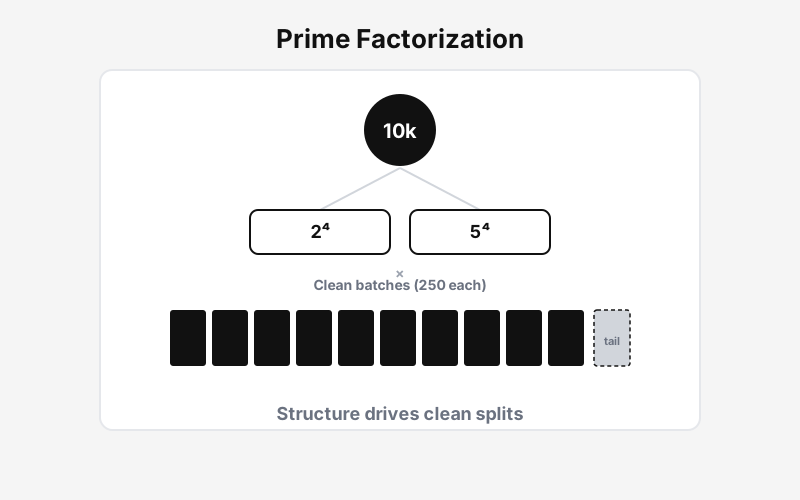
The idea
Prime factorization is usually taught as a mechanical exercise. You take a number and break it into its smallest building blocks.
For example:
10,000 = 2⁴ × 5⁴
Most of us stop there. We have "solved" the problem.
But this way of thinking misses the point. Prime factorization is not just about simplifying numbers. It is about understanding the structure behind them.
Why structure matters
When you look at 10,000 as a single number, it is hard to work with. When you look at it as 2⁴ × 5⁴, patterns start to appear.
You can immediately see that the number is highly divisible. It can be split into clean, even parts without awkward remainders. That structure gives you flexibility.
This matters because most real world problems are not about numbers. They are about how efficiently you can divide and organize work.
Example: break the total, then pick a batch size
Prime factorization shows how a total is built. Clean batch sizes divide it with nothing left over. Drag the slider or tap a preset to compare a clean split vs a messy partial tail.
Total
10,000
records
Factorization
2⁴ × 5⁴
10,000 mixes 2 and 5. That gives you many even batch sizes without awkward remainders.
1. Scenario
Nightly ETL job processing customer records
2. How the number is built
Prime building blocks
10,000 = 2⁴ × 5⁴
3. Batch size
4. What the split looks like
Batch split (full vs partial)
40 equal batches
Batch size
250
Full batches
40
Leftover
None
- Full batch
- Partial / leftover
Clean split. 40 jobs each handle 250 records with no straggler batch.
The math
Every whole number breaks into prime building blocks. That structure tells you which batch sizes divide evenly and which leave a messy remainder.
Prime factorization
The exponents tell you how many times each prime appears. From that you know 10,000 is divisible by 2, 4, 5, 10, 16, 25, 50, 100, and other combinations of those primes.
When a batch size works
If 10,000 ÷ 250 = 40 with no remainder, you get 40 equal jobs. If you pick 300, you get 33 full batches and 100 records left over. That tail batch is extra scheduling and uneven worker load.
Counting clean split options
For 10,000 = 2⁴ × 5⁴, divisors = (4 + 1)(4 + 1) = 25. You have 25 clean batch sizes to choose from, not an infinite list of arbitrary picks.
Numbers with many small prime factors offer more clean splits; a prime total like 10,007 only divides evenly by 1 and itself. Pick a divisor of N and remainders disappear; pick anything else and you inherit a tail batch. Factorization gives you options; staffing and worker count decide which split fits the operation. The same logic applies beyond ETL: shift hours, event seating, inventory packs, and budget splits all work better when total size factorizes cleanly against your chunk size.
A simple application: batching
Imagine you are processing 10,000 records in a data pipeline. If you do not think about structure, you might choose arbitrary batch sizes like 300, 700, or 1,200. That often leaves a partial batch at the end, uneven worker load, and extra scheduling overhead.
Batching 10,000 records without orphan batches
Drag batch size. See remainder batches and uneven worker load when size does not divide evenly.
14 full batches + orphan 200 records
Batch structure
Worker load index
Even split: 100 · Your split: 110
Batch size
700
Full batches
14
Orphan records
200
Optimize (move here)
- • Pick batch sizes that divide total records evenly
- • Factor the job count before scheduling
Hold (do not over-react)
- • Random batch sizes that leave partial batches every run
Escalate if
- • Orphan batch exceeds 5% of total volume
Try 500 (factor of 10,000) to eliminate remainder and simplify scheduling.
Factorization tells you that clean sizes exist: 100, 200, 250, and 500 all divide 10,000 with nothing left over. Those are not random picks. They come from how the number is built.
| Batch size | Jobs needed | Leftover | Ops read |
|---|---|---|---|
| 100 | 100 | None | Clean split |
| 200 | 50 | None | Clean split |
| 250 | 40 | None | Clean split |
| 500 | 20 | None | Clean split |
| Batch size | Jobs needed | Leftover | Ops read |
|---|---|---|---|
| 300 | 33 + partial | 100 | Partial batch runs at 33% load, wastes worker time |
| 700 | 14 + partial | 200 | Partial batch runs at 29% load, wastes worker time |
| 1200 | 8 + partial | 400 | Partial batch runs at 33% load, wastes worker time |
Prime factorization is a way of asking what something is made of. Once you understand that, decisions become more straightforward. You can choose better ways to divide work, design systems, and avoid unnecessary complexity.
This idea applies beyond data pipelines. It shows up in resource allocation, scheduling, system design, and even financial planning. When you understand structure early, you avoid fixing problems later.
Most problems feel complex because we try to handle them as a whole. Once you understand what they are made of, the decisions around them become much simpler. Prime factorization reveals structure early, so you can design cleaner and more efficient solutions instead of fixing issues later.