Math, Applied
Twelve Data Points Isn't a Trend: What Sample Size Changes in Real Decisions
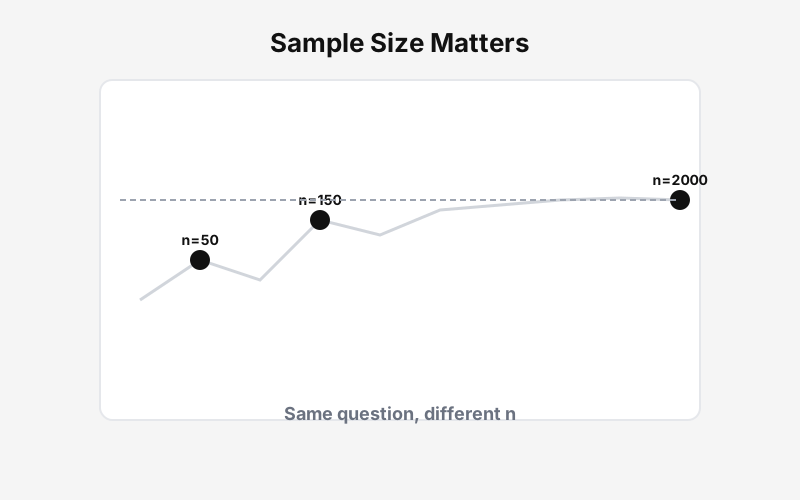
The idea
Every metric you report is computed from a sample. A conversion rate from last week, an average order value from thirty customers, a CSAT score from one survey batch. The number on the slide is only as trustworthy as the sample behind it.
Sample size is how many observations you include. Small samples are not wrong, but they are noisy. The same underlying business can look like a breakthrough, a disaster, or a flat result depending on how many data points you have.
Sample size answers: Do we have enough evidence to act, or are we reacting to noise?
The math
Sample size controls how much random noise shows up in your summary stats. Larger n does not remove bias, but it does stabilize the numbers.
Core idea: noise shrinks with the square root of n
Quadrupling sample size roughly halves the typical wobble in your mean or rate. That is why going from 50 to 200 observations helps more than going from 50 to 100, but each doubling of n buys less and less stability.
Standard error for a proportion (conversion, CSAT yes/no)
p is the observed rate (e.g. 12% conversion). n is sample size. At p = 0.12 and n = 100, SE ≈ 3.3 percentage points, so a read of 12% might really be somewhere near 9% to 15%. At n = 1,600, SE ≈ 0.8 points. Same rate, much tighter estimate.
Standard error for an average
s is the sample standard deviation. More observations shrink the uncertainty around your average order value or handle time. The explorer shows how means and rates jump when n is small and settle when n grows.
Larger n stabilizes summaries: experiment lifts stop flipping sign and percentiles settle, especially in the tail. Noisy processes and rates near 50% stay wide even with more data. Slice the sample by region or device and n per slice drops; a trend that looks clear overall can vanish in each subgroup. More rows reduce random noise, not systematic bias, so report n alongside every rate and average so the audience can judge how much to trust the headline.
Why small samples mislead teams
When n is small, summary stats move easily. Mean, median, conversion rate, and percentiles can shift sharply if a few customers behave differently. That movement is not always a real change in the business. It is often sampling noise.
This shows up in weekly reviews, experiment readouts, and pilot programs. A product leader sees variant B ahead by nine points on conversion and wants to ship. Finance sees average order value up eighteen dollars on forty orders and raises targets. Support sees CSAT jump after a training session with ninety responses.
Each decision uses real numbers. The risk is treating a thin sample as if it were the full customer base.
Business examples and impact
A/B tests. Experiments compare conversion, click-through, or revenue per user between groups. With a small sample, the variant can look like a clear winner even when the underlying populations are nearly the same. The business impact is premature rollout, wasted engineering time, or rolling back a change that was actually fine.
Revenue and unit economics. Average order value, revenue per user, and cost per acquisition all depend on sample size. A short window with few orders can inflate or deflate the mean. The impact is mispriced promotions, wrong bonus plans, and forecasts that do not survive the next month.
Operations and quality. CSAT, handle time, and defect rates from a single week reflect process changes, staffing, and seasonality. Small samples make it hard to separate signal from noise. The impact is restructuring workflows or changing policies based on a blip.
What to look at besides the headline
You need a habit: report n alongside every summary, then ask how stable that summary would be if you kept collecting data. The formulas above show why that habit works.
Useful companions include the mean and median for level, spread for volatility, percentiles for tail experience, and the gap between your sample and a longer baseline. For experiments, compare observed lift to what you would expect from small noise, and wait for the readout to stop jumping before you ship.
A practical rule: if the decision is expensive to reverse, require a larger sample or a longer time window. If the decision is cheap to test, you can move faster, but still label early results as directional, not final.
Sample size is not a technical footnote. It is a business risk control. Leaders who always ask how many observations sit behind a metric make fewer false positives and fewer panic pivots.
Good dashboards show n next to rate and average. Good experiment reviews show how the result changed as traffic accumulated. Good operations reviews compare this week to a band of normal weeks, not to a single small batch.
Data quality is not only about clean pipelines. It is about whether you have enough observations to support the story you tell. Before you change pricing, ship a feature, or restructure a team, ask one question: if we had twice as much data, would this conclusion still hold?
If the answer is no, you do not have a trend yet. You have a starting point. Treat it that way.
A simple application: how tight can you measure?
Move sample size and baseline rate. Watch margin of error shrink before you ship a readout.
Sample size: how tight can you measure?
Move sample size. Watch margin of error shrink as n grows — before you lock a readout.
n=3,000 → margin of error ±0.97 pp at 95%
Margin of error vs n
Your readout band (pp)
Low: 7.0% · Rate: 8.0% · High: 9.0%
Sample / arm
3,000
Margin of error
±0.97 pp
Baseline
8.0%
Optimize (move here)
- • Pre-register n from baseline rate before launch
- • Show interval width in readout doc
Hold (do not over-react)
- • Shipping on ±3 pp bands when decision threshold is 1 pp
Escalate if
- • Observed lift sits inside the margin of error
Precision is reasonable for many product decisions at this baseline.