Math, Applied
Correlation Isn't Causation: How Linked Data Misleads Real Decisions
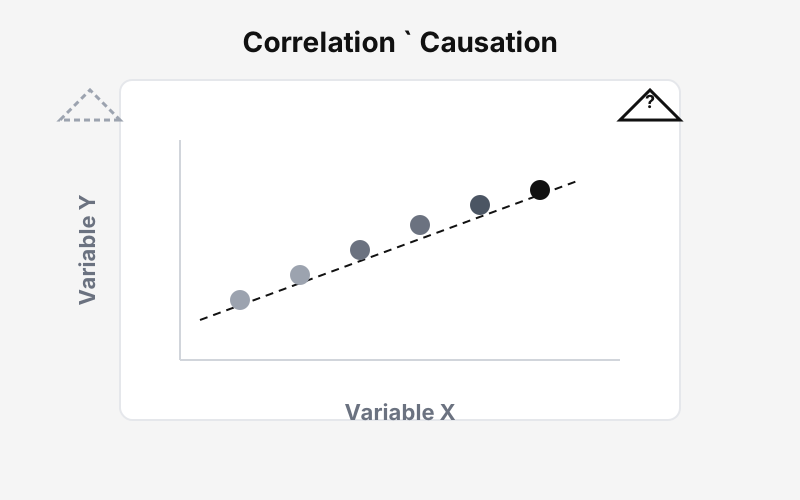
The idea
When two metrics move together, it is tempting to say one causes the other. Dashboards make this easy: you see a line going up, another line going up, and a strong correlation coefficient. The story writes itself.
Correlation only answers one question: do these two variables tend to rise and fall together? It does not tell you whether changing one will change the other.
Correlation is a pattern. Causation is a claim about what happens when you intervene.
That distinction sounds academic until it drives budget decisions, product bets, or policy changes. Teams often act on correlated metrics and later discover the lever they pulled was not the real driver.
Example: correlation is not causation
Pick a real-world pattern, read the correlation, then reveal the hidden factor. The scatter plot stays the same — the interpretation changes.
Correlation (r)
+0.86
Causal claim from r alone?
Still no
Strong correlation — easy to tell a causal story
Ice cream sales and drowning deaths move together across weeks. Correlation is high, but neither variable is driving the other.
Correlation measures how two variables move together (+0.86 here). It does not tell you whether X causes Y, Y causes X, or a third factor drives both.
Checklist: what supports a causal claim?
Strong correlation is only the starting point. Toggle what you would need before acting on a causal story in a product or policy decision.
With correlation only, you have a hypothesis — not a safe basis for intervention.
The math
Correlation summarizes how two variables move together. It does not tell you which one causes the other.
Pearson correlation coefficient
r near +1 means when X rises, Y tends to rise. r near −1 means when X rises, Y tends to fall. r near 0 means little linear relationship. The explorer scenarios show r values that look convincing but come from confounders, not direct cause.
Coefficient of determination
If r = 0.85, then r² ≈ 0.72, meaning about 72% of the linear variation in Y aligns with X. The other 28% comes from other factors, noise, or a non-linear relationship. High r² still does not prove that changing X will change Y.
A hidden third variable can inflate r even when neither metric causes the other. Outliers and small samples can do the same. Pearson r only captures linear co-movement, so a curved relationship can look weak on paper while still mattering in practice. A strong r is worth investigating, but causation still needs mechanism, timing, and ideally a controlled test. r² tells you how much linear variation lines up; neither number proves that pulling one lever will move the other.
Why correlation breaks intuition
Two variables can correlate for three common reasons, and only one is direct causation. X might cause Y. Y might cause X. Or a third factor Z might drive both.
The third case is the most common in real data. Seasonality, product launches, user segments, and operational constraints create shared movement that looks like a causal link.
This is different from a weak correlation. Even a very strong r can be completely non-causal. The math is doing its job. The interpretation is where teams get hurt.
A simple application: marketing and revenue
Imagine weekly ad spend and weekly revenue correlate at r = +0.85. Leadership concludes that increasing ads will reliably increase revenue.
Marketing and revenue: correlation vs causation
Increase confounding (launch weeks). Ad spend and revenue move together — but part of lift may not be from ads.
r ≈ 0.80 — but only part of revenue lift is ad-driven
Revenue index
Correlation strength
Low confound: r=0.50 · You: r=0.80 · High confound: r=0.95
Correlation
~0.80
Ad-driven lift
+0.0 idx
Confound lift
+8.4 idx
Optimize (move here)
- • Holdout or geo test before scaling spend
- • Track launch calendar beside ad/revenue charts
Hold (do not over-react)
- • Budgeting every correlated dollar as incremental
Escalate if
- • Spend up, revenue flat after controlling launches
Correlation answers: do they move together? Causation needs a design change or control. Budget as if confounding is real.
But several launch weeks appear in the same period. During those weeks, the company spent more on ads and also sold more because of the launch itself. Ads and revenue moved together, yet part of the lift may have happened even at the same spend level.
Correlation answers: Do these metrics move together?
Causation answers: If we change X, what happens to Y?
Those are different planning questions. Budgeting as if every correlated dollar of ad spend caused incremental revenue can overfund channels that are riding along with something else.
The same pattern appears in product analytics: feature usage and retention may rise together because engaged users both adopt features and stay longer, not because the feature itself caused retention for everyone.
Good data work treats correlation as a signal to investigate, not a conclusion to ship. Before acting, teams ask what else could explain the pattern, whether cause precedes effect, and whether a controlled test is possible.
In practice, the strongest decisions combine observational correlation with design: hold other factors steady, measure confounders, and run experiments when stakes are high. When experiments are not possible, be explicit about uncertainty instead of hiding it behind a high r.
Correlation is cheap to compute and easy to communicate. Causal claims are harder, but that difficulty is the point. It forces you to name the mechanism, the timing, and the alternative explanations before you scale a change.
Most costly mistakes in analytics are not calculation errors. They come from treating correlation as proof.
When you separate pattern from intervention, you make better bets: you stop asking only what moves together and start asking what you can actually change. That shift is what turns a chart into a decision you can defend.