Math foundations
Entropy and Information Gain: How a Split Reduces Uncertainty
The idea
A pile of rows that is 50% fraud and 50% legit is maximally uncertain — a coin flip. A pile that is 99% legit is nearly settled. Entropy puts a number (in bits) on that uncertainty. Information gain measures how much a yes/no split shrinks it, and that is exactly how a decision tree decides which question to ask first.
Entropy answers: how uncertain is this label mix? Information gain answers: how much did this split clean it up?
Example: how much a split reduces uncertainty
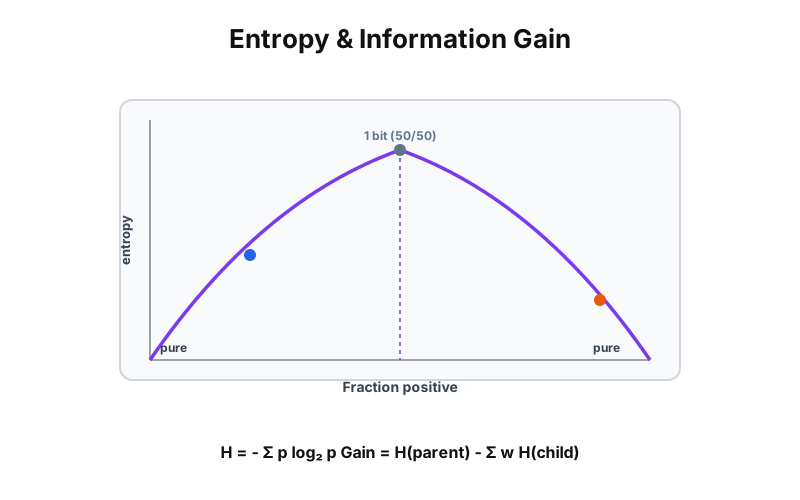
The curve is entropy for a two-class node: highest at a 50/50 mix, zero when pure. Set the parent mix, then split the rows into two children. Information gain is the drop in weighted entropy.
Parent entropy
1.00
Weighted children
0.61
Right child is 15% positive.
Information gain
0.39
The parent node carries 1.00 bits of uncertainty. After the split the weighted child entropy drops, leaving 0.39 bits of information gain — a useful split. A tree greedily picks the feature with the highest gain.
The math
Entropy (bits)
Sum over each class probability pᵢ. For two classes, entropy peaks at 1 bit when the split is 50/50 and falls to 0 when the node is pure. Rare classes contribute little.
Information gain
Subtract the size-weighted entropy of the children from the parent's entropy. A tree evaluates this for every candidate feature and greedily picks the highest gain.
A simple application
Information gain is the splitting criterion behind decision trees (Gini impurity is a close cousin). The same entropy term is the cross-entropy loss classifiers minimize, and it connects to maximum likelihood: minimizing cross-entropy is maximizing the likelihood of the labels.