Math foundations
Bayes Theorem: Update Belief When New Evidence Arrives
The idea
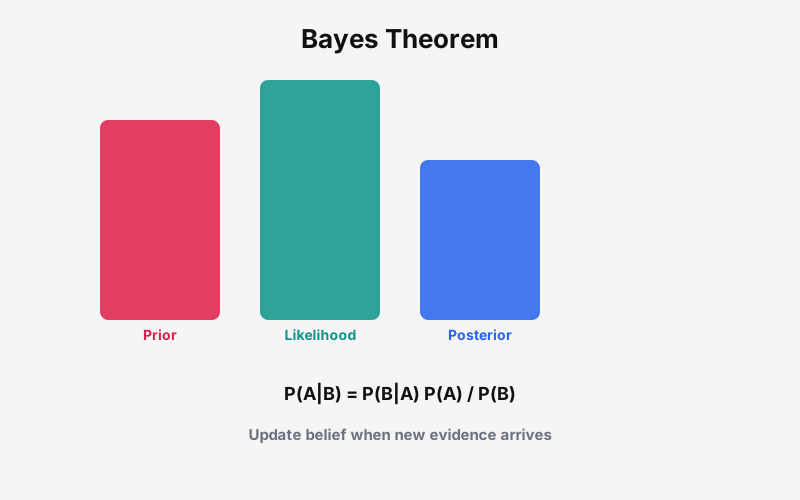
You start with a prior: how common the event is before new data. A test or alert arrives. Bayes theorem tells you how to revise belief. The posterior is not the test accuracy alone. It blends how often the signal fires on true cases and false cases with the base rate.
Screening is the textbook case. High sensitivity means most sick patients test positive. That is P(positive | disease). Clinicians and reviewers need P(disease | positive), which is the reverse question and requires Bayes.
Bayes answers: After seeing evidence B, what is the updated chance of A?
Example: prior, likelihood, and posterior
Bayes combines what you believed before the signal with how often the signal appears when the event is true or false. Drag sliders to see P(disease | positive) update.
A positive test updates belief, but the prior base rate still sets the starting point.
Prior
2.0%
Posterior
19.5%
Bayes components
P(positive): true vs false
P(Has disease | Positive test) = 19.5%. Prior was 2.0%; the positive signal raised belief, but 80.5% of positives are still false alarms at these rates.
The math
Bayes theorem
Posterior equals likelihood times prior, divided by the overall rate of evidence B. All terms are probabilities between 0 and 1.
Law of total probability
The denominator sums true positives and false positives across the population. This is the expanded form you use when only sensitivity and false-positive rate are known.
Odds form (optional)
Likelihood ratio LR = P(B|A) / P(B|not A) multiplies prior odds. Same update, different bookkeeping when you think in odds instead of probabilities.
A simple application
When a fraud model fires, report the posterior chance of fraud given that alert, not just recall on known fraud. Include base rate and false-positive rate in the readout so reviewers know how many alerts to expect per true hit.
Build on conditional probability, base rates, and sensitivity-specificity. Bayes is the glue that turns those pieces into an updated belief.